Search any major project management platform and you'll find the word "intelligence" everywhere. Wrike calls their analytics suite "Work Intelligence®." Monday.com has "AI-powered insights." Smartsheet uses "predictive analytics." Asana touts "goals intelligence."
And yet project failure rates have barely moved in a decade. According to PMI's Pulse of the Profession research, a substantial share of projects fail to meet their original goals and business intent. That gap — between tools that claim to be intelligent and organizations that still can't see project risk coming — raises an obvious question:
What does project intelligence actually mean? And why isn't what most tools call "intelligence" actually solving the problem?
This guide answers both questions directly.
The Standard Definition — and Why It Falls Short
The most common definition of project intelligence you'll find in vendor marketing is some variation of: turning project data into insights for better decision-making.
That sounds reasonable until you notice what it's describing: dashboards. Better reporting. More ways to visualize what you already know.
A dashboard showing task completion rates, budget burn, and milestone status is useful. It is not intelligent. Intelligent means the system does something with the data beyond displaying it — something a human analyst reviewing the same spreadsheet could not practically do on their own.
Working Definition
Project intelligence is the capability to detect early warning signals from project data — before problems become visible in status reports — and translate those signals into actionable foresight for the people responsible for delivery outcomes.
The operative word is before. That's what separates intelligence from visibility. Visibility tells you where you are. Intelligence tells you where you're heading.
Project Intelligence vs. Project Management Software
It helps to be precise about what different categories of tools actually do:
| Tool Category | Primary Function | Core Question Answered | Signals Risk? |
|---|---|---|---|
| Project Management Jira, Asana, Monday.com |
Organize, assign, and track work | Where are we right now? | No |
| Work Automation / "Intelligence" Wrike Work Intelligence® |
Automate tasks, visualize dashboards, AI content generation | How do we work faster? | No |
| Project Reporting / Analytics Smartsheet, ProjectManager.com |
Aggregate and display project data | What has happened so far? | No |
| Project Intelligence Purpose-built platforms |
Detect early risk signals across projects and portfolios | What's about to go wrong — and when? | Yes |
Notice that "Work Intelligence®" — a trademarked product from one of the largest project management platforms in the world — sits in the automation and dashboards row, not the intelligence row. That's not a knock on the product: Wrike is an excellent work management platform. But renaming dashboards "intelligence" does not make them predictive.
The Four Layers of Real Project Intelligence
True project intelligence isn't a single feature. It's a stack of capabilities that builds from data collection through to foresight. Each layer is necessary; none is sufficient on its own.
Layer 1
Signal Collection
Continuous ingestion of project data across schedule, budget, resource allocation, vendor activity, and stakeholder communication. Not a weekly snapshot — a live data feed.
Layer 2
Anomaly Detection
Identifying deviations from expected patterns in that data — a milestone creeping, a resource being pulled from critical-path work, a vendor response time lengthening. Pattern, not just point-in-time data.
Layer 3
Risk Signal Interpretation
Translating anomalies into risk signals. Not every deviation is dangerous. Intelligence means distinguishing noise from signal — and explaining which combination of factors actually predicts downstream problems.
Layer 4
Actionable Foresight
Surfacing risk signals in time for intervention — with enough context for a decision-maker to act on them. A warning that arrives after the delay has already started is reporting, not intelligence.
Most project management software handles Layer 1 passively (data lives in the tool) and stops there. Most "intelligent" work platforms add visualization at Layer 1 and call it Layer 4. The gap between Layers 1 and 4 is exactly where project failures hide.
The Five Signals Project Intelligence Watches
What kinds of signals does a project intelligence platform actually track? The most consequential risk signals fall into five categories — and they rarely announce themselves as problems when they first appear:
The challenge isn't that these signals don't exist. It's that no single signal in isolation is alarming. A resource reassignment looks routine. A vendor reply that takes two extra days seems minor. It's the combination and sequence of these signals — across multiple projects simultaneously — that predicts a delivery problem. That combination is what project intelligence is built to detect.
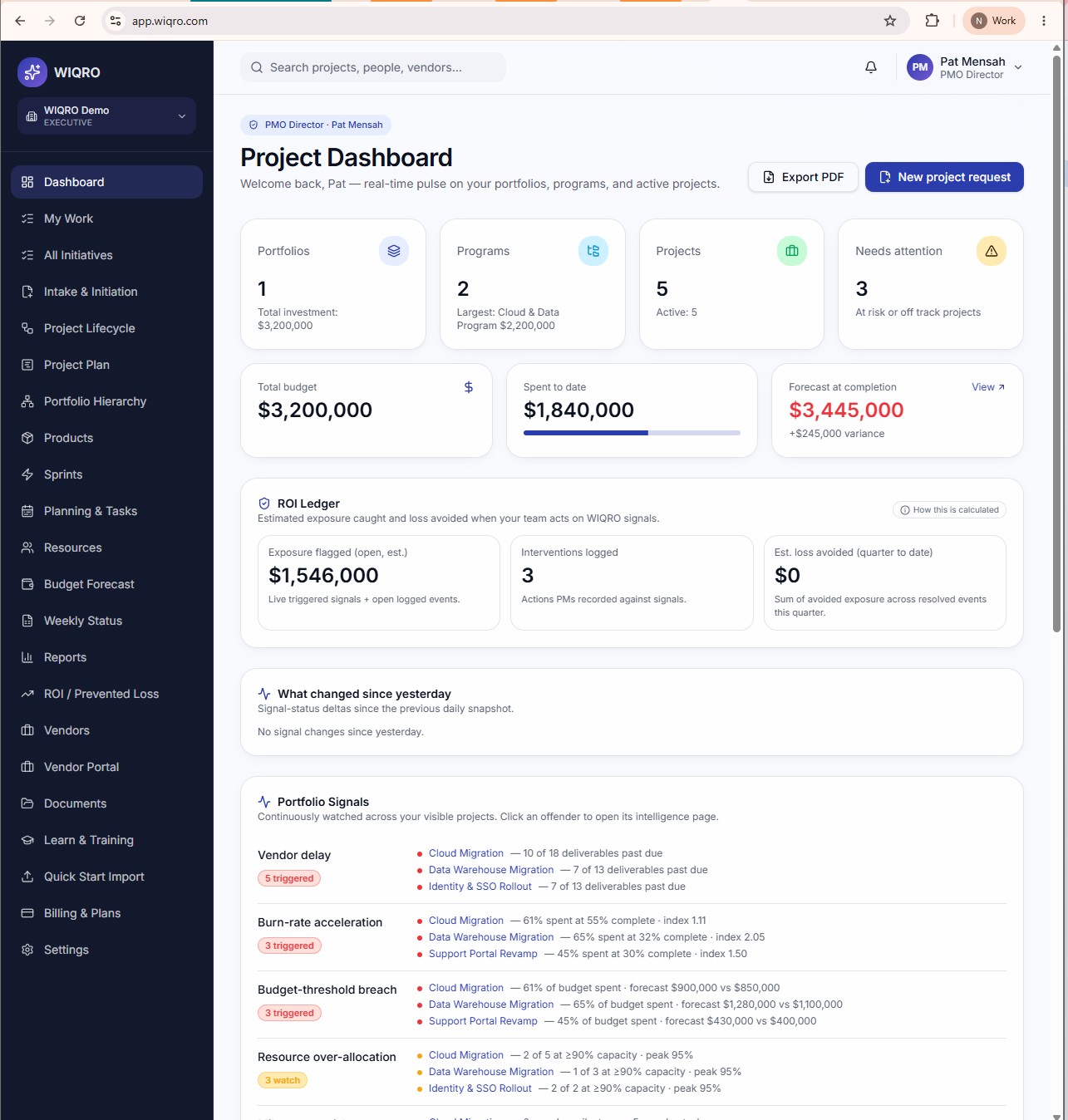
WIQRO's Portfolio Signals dashboard — continuously watched across all active projects. The signals shown (vendor delay, burn-rate acceleration, budget-threshold breach) are exactly the combinations that precede project delivery problems. Demo data from WIQRO's demo workspace.
Why More Dashboards Don't Solve the Problem
The honest answer to why so many organizations still struggle with project visibility despite investing in sophisticated work management tools is this: better visualization of project data doesn't help you catch what you can't see yet.
Dashboard fatigue is real in organizations running more than five active projects. Leaders receive weekly status reports where every project is green or yellow. The red projects are the ones everyone already knew about. The dangerous projects — the ones that are about to turn red — look fine in the report because the signals are subtle and distributed.
The visibility paradox: The more projects an organization runs, the less useful individual project dashboards become. At ten active projects, a PMO leader cannot manually synthesize fifteen data points per project across their portfolio every week and reliably catch the one project that is quietly drifting toward a problem. That's not a process failure — it's a scale problem that tools designed for individual project visibility cannot solve.
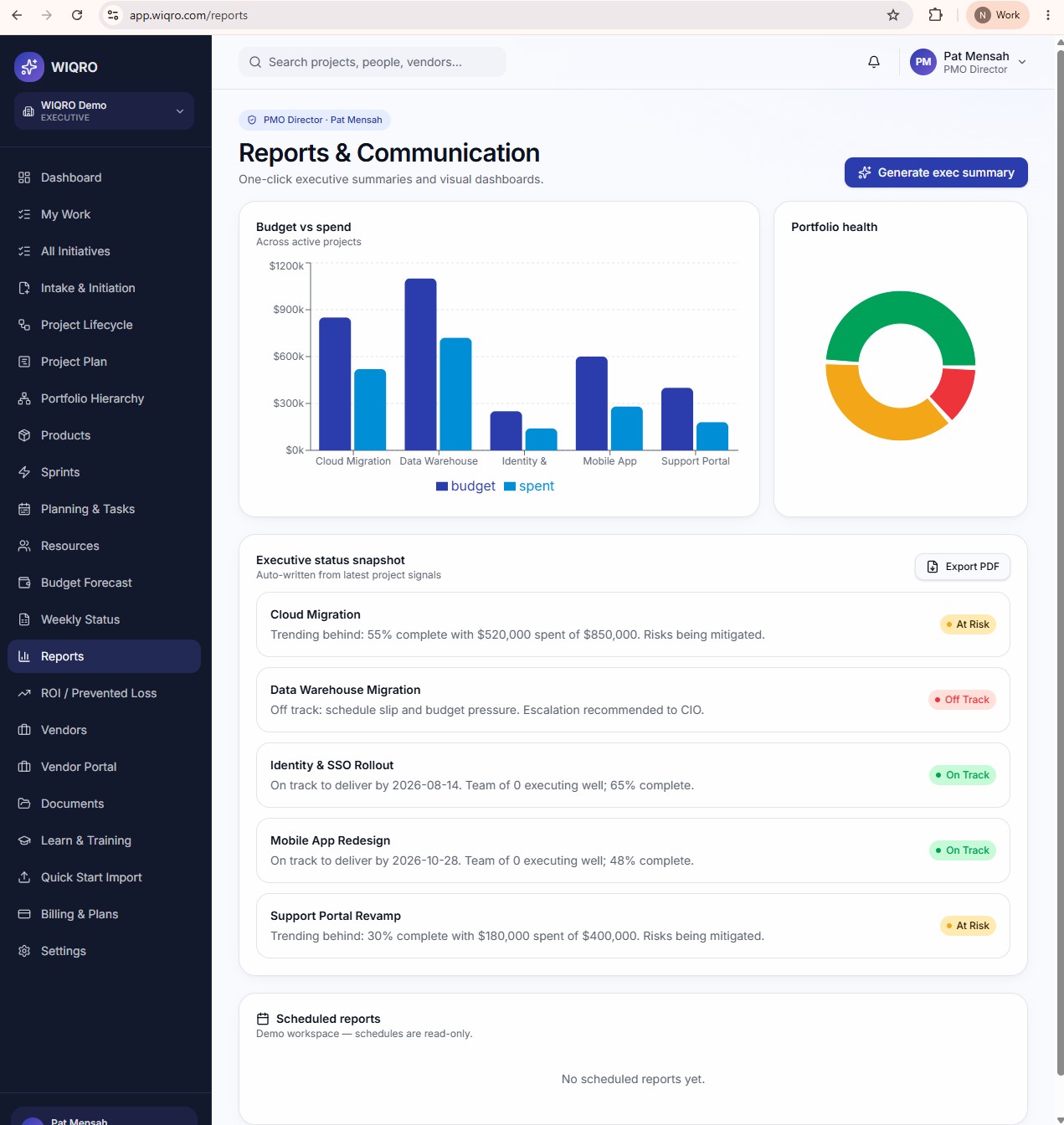
WIQRO's executive status snapshot — auto-written from the latest project signals, with one-click PDF export. The Portfolio health view (right) shows the distribution across At Risk, Off Track, and On Track — surfacing the aggregate picture that no individual project report provides. Demo data.
Project intelligence approaches the problem differently. Instead of asking "can leadership see the data?" it asks "can the platform connect the dots across the portfolio so leadership doesn't have to?"
Project Intelligence at the Portfolio Level
For organizations with multiple active projects, project intelligence has a dimension that goes beyond individual project health: portfolio-level risk detection.
Portfolio-level intelligence catches risks that are invisible if you're only looking at projects one at a time:
- Resource concentration risk — three critical projects all depending on the same two subject matter experts, with no visibility that a slip on any one of them will cascade to the others.
- Cross-project contagion — a vendor delay on Project A that also supplies a dependency for Project C and Project D, turning one vendor problem into a three-project risk.
- Budget ceiling compression — a portfolio approaching its total approved budget while individual projects still show healthy variances, with no one seeing the aggregate picture.
- Milestone clustering — three major deliverables with executive visibility landing in the same two-week window, with shared approval dependencies and resource competition that doesn't show up in any individual project plan.
These aren't unusual scenarios. They're the normal operational reality for any organization running a multi-project portfolio. They're also the scenarios that surprise leadership most often — because no individual project dashboard shows them.
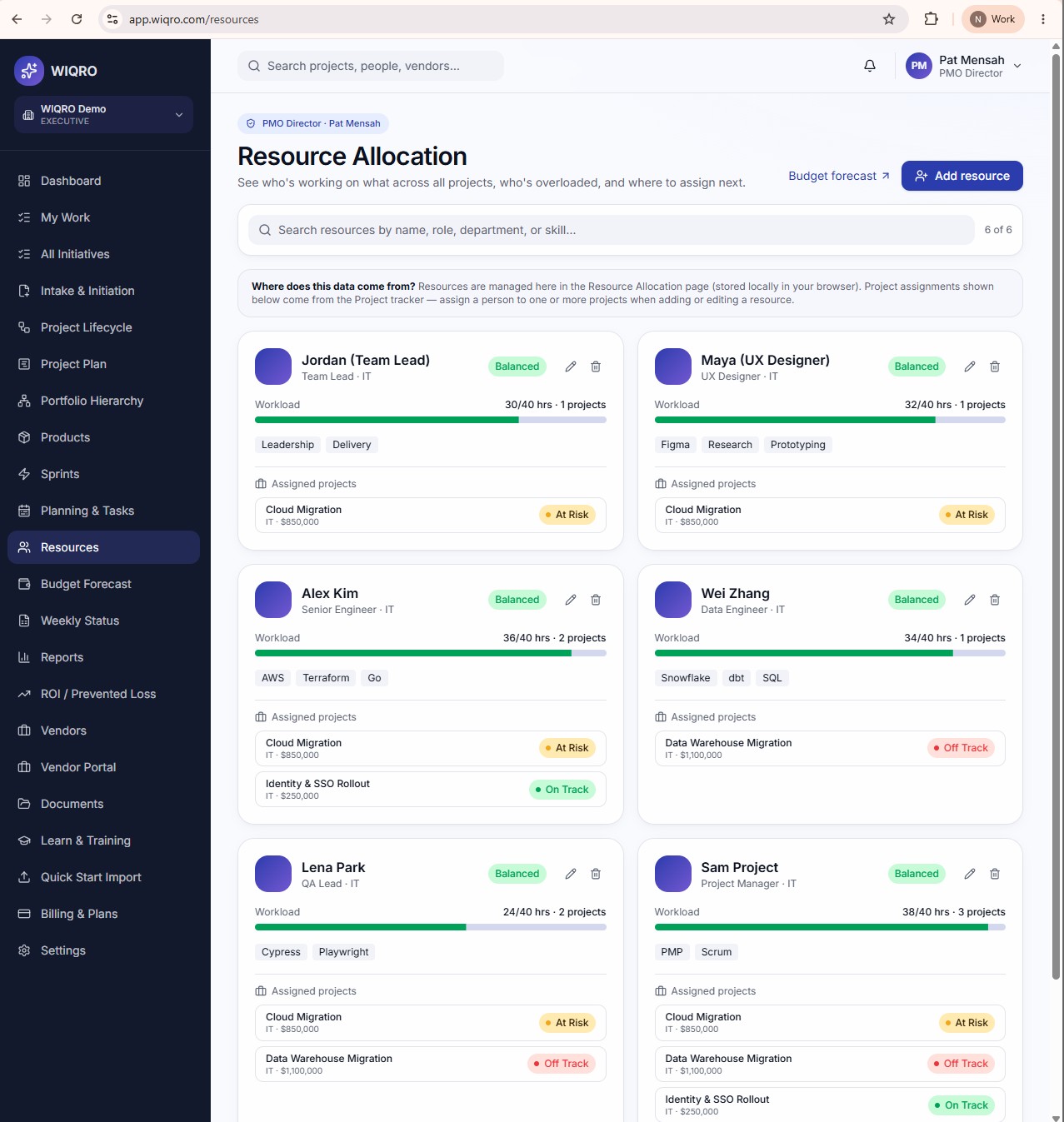
WIQRO's Resource Allocation view — showing who's working on what across all projects simultaneously. Alex Kim (Senior Engineer) is assigned to both Cloud Migration (At Risk) and Identity & SSO Rollout (On Track). Sam (Project Manager) carries three active projects including two flagged as At Risk or Off Track — a resource concentration risk that is invisible in any single project view. Demo data.
How AI Advances Project Intelligence
Artificial intelligence changes what's possible in project intelligence in two important ways.
The first is scale. A human analyst reviewing project data manually can monitor a handful of projects with focused attention. AI can monitor every project in a portfolio simultaneously — every task update, every budget transaction, every vendor communication — and flag anomalies as they emerge, not after the weekly review cycle.
The second is pattern recognition across time. AI can learn which combinations of signals, across past projects, preceded delivery problems — and detect when those same patterns are developing in a current project before the delivery problem materializes. That's the difference between describing what happened on previous projects and using those patterns to predict what's about to happen now.
It's worth being precise about what AI doesn't do here: it doesn't make decisions. It doesn't manage the project. It doesn't replace the judgment of an experienced PMO leader or project sponsor. What it does is give that leader an earlier, cleaner signal about where their attention should go — before the situation has escalated to the point where the options are limited.
What to Look for in a Project Intelligence Platform
If you're evaluating whether a tool genuinely provides project intelligence or is rebranding dashboards as intelligence, these are the questions that matter:
- Does it surface risk signals before they appear in status reports? If the tool only shows what's already visible in weekly updates, it's reporting — not intelligence.
- Does it monitor across the portfolio simultaneously? Individual project views are necessary but not sufficient. Portfolio-level signal detection is the capability that prevents surprises at scale.
- Does it explain why a risk signal is flagged? "This project is at risk" isn't actionable. "This project shows three signals that in past projects preceded a 2–3 week schedule slip" gives a decision-maker something to work with.
- How early does the warning arrive? The lead time between a risk signal and the point where intervention is still practical is the key performance variable in any intelligence platform.
- Is the output formatted for executive decision-making? Intelligence surfaced in a format that requires a project manager to translate it before an executive can act on it adds a delay that erodes its value.
The Strategic Case for Project Intelligence
The reason project intelligence matters at the organizational level is straightforward: project delivery is how strategy becomes execution. A plan that exists in a spreadsheet does nothing. The organization's ability to consistently deliver projects on time and on budget is the operational foundation of its strategic credibility.
When projects fail, the damage isn't just the cost of the failed project. It's the opportunity cost of what the organization couldn't do while resources were tied up managing the failure. It's the credibility damage when leadership promises aren't kept. And in regulated industries or government contracting, it's the compliance and contract risk that comes with delivery failure.
Project intelligence doesn't eliminate project risk. No tool does. What it does is compress the time between when a risk begins developing and when the organization can respond — and in delivery management, that lead time is often the entire margin between a project that recovers and one that becomes a problem.
Frequently Asked Questions
What is project intelligence?
Project intelligence is the capability to detect project risk signals early — before problems become visible in status reports — and translate raw project data into actionable foresight. It goes beyond dashboards and reporting to tell leaders what is likely to go wrong, when, and why.
What is the difference between project intelligence and project management software?
Project management software (Jira, Asana, Monday.com) organizes and tracks work. Project intelligence analyzes the patterns in that work to detect early warning signals. Management tools answer "where are we?" — intelligence tools answer "where are we heading and what could derail us?"
Is project intelligence the same as project analytics or dashboards?
No. Dashboards show you what has already happened. Project analytics visualize historical and current data. Project intelligence uses that data — plus pattern recognition and AI — to surface what is about to happen. The difference is between seeing a problem after it arrives versus getting a warning before it does.
What does a project intelligence platform actually do?
A project intelligence platform continuously monitors project data across schedule, budget, resource, vendor, and stakeholder signals. It identifies anomalies and risk patterns — like schedule compression across dependencies or vendor lag on a critical path item — and surfaces them as early warnings before they escalate into delays or cost overruns.
Who needs project intelligence?
PMO leaders, portfolio managers, CIOs, and COOs responsible for multi-project delivery benefit most from project intelligence. Organizations running more than 3–5 active projects simultaneously — especially those with cross-project dependencies or shared resources — are most exposed to the risks that intelligence platforms are designed to catch.
How is AI used in project intelligence?
AI in a project intelligence platform detects signals that would be impossible for a human analyst to catch at scale — recognizing that a combination of resource reassignment, milestone slip, and vendor communication lag on a past project preceded a delay, and flagging the same pattern developing on a current project before the delay occurs.